Poetry
Category: Individual Collections, Poetry
Number of pages: 72
ISBN: 9781781723739
Publication date: February 27, 2017
Price: £9.99
Out of stock
Longlisted for the Michael Murphy Memorial Prize 2019
‘With her keen senses, she celebrates nature in all its glory. ’ – Disclaimer Magazine
‘Powerful and tender’ – Mslexia
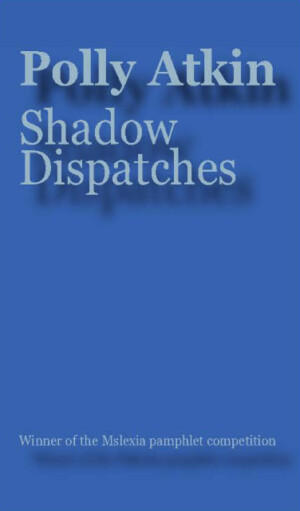
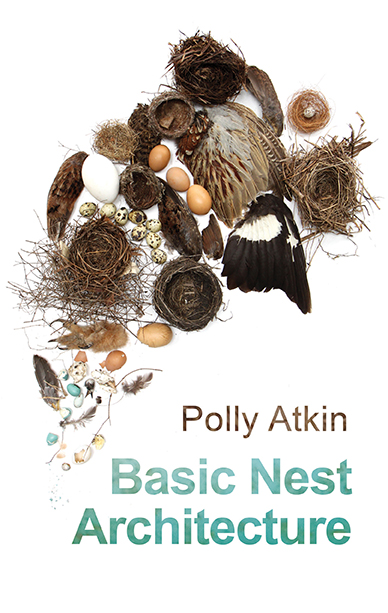
Basic Nest Architecture, Polly Atkin’s first collection of poetry, marks a startling new talent. Known for a couple of prize-winning pamphlets, including her Seren/Mslexia prize-winning Shadow Dispatches, and her Michael Marks nominated Bone Song, and widely shortlisted for competitions, Atkin has already built up a loyal readership for her complex, intelligent, densely metaphorical lyrics, often inspired by the beauties of the Lake District where she has made her home for a decade.
The book is divided into three sections: the first contains poems quite directly inspired by the poet’s move from the city to the Lakes. In the beautifully bee-haunted (And Troubadour prize-winning) ‘Colony Collapse Disorder’ the protagonist says “To leave the City was to leave one’s memory./Outside was a garden gone wild.” The poems begin to discover and enact the spells cast by nature, landscapes and animals become charged with tension as in ‘Heron/Snow’ where the bird carries “worlds in the cipher of your feathers.” Later, one of the lakes appears like “a blue-green iris of one great eye”. The poet’s imaginative grasp excludes cliché, and she expertly grapples with her own animal obsessions as in the lively ‘Road-Kill’.
Most of section two moves back in time and uncovers earlier locations and subjects. It is clear that the celestial heavens, weathers and things seen from city windows inspired the poet earlier in her development. But there is a distinct sense of claustrophobia in some of the poems like ‘Dreams’: “You are sick to death of my dreams./I drag them out, one after the other.” The wonderful ‘Strength in Winter’ is a parade of glorious detail concerning the Constellation Leo in all its manifestations, it is a full-bodied fantasy to console the protagonist for the gloom of the season.
The final section contains more painful work, literally and figuratively. These poems are hints from the autobiography of the poet who suffered for many years from a mysterious and debilitating illness. The poem ‘Begin’ recalls a sixteen-year old, purloining doctor’s letters from her mother’s handbag so she could try to secretly decipher them, as if it is almost a game: “then you play medical snap with the encyclopedia, trying to match up your blood with its names.” Other poems are less literal, but use these experiences to reach-out towards a wider metaphor, such as in ‘Imaging’ where an MRI inspires musing on other dimensions “I met its whirling motion in the dark”.
The remarkable poems in Basic Nest Architecture are a testament to the persistence and artistry of Polly Atkin. As well as being profoundly personal, they reach out to the modern world in all its complexity and diversity.

Polly Atkin
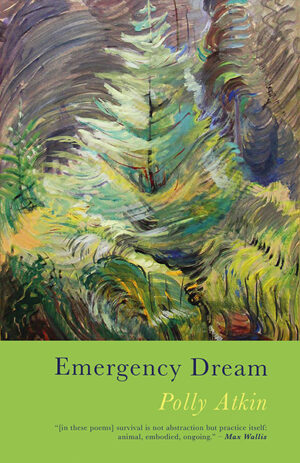
Polly Atkin (FRSL) is a poet and non-fiction writer whose work focuses on nature, place and disability. Her poetry collections are Basic Nest Architecture (Seren Books, 2017), Much With Body (Seren Books, 2021) and Emergency Dream (Seren Books, 2026). Her non-fiction books include Recovering Dorothy: The Hidden Life of Dorothy Wordsworth (Saraband, 2021), Some Of Us Just Fall: On Nature and Not Getting Better (Sceptre, 2023) – Lakeland Book of the Year 2024 and longlisted for the Wainwright Prize for Nature Writing 2024 – and The Company of Owls (Elliott and Thompson, 2024). Her poetry and prose appears in various anthologies and academic editions.
She grew up in Nottingham then lived in East London for seven years before moving north to Cumbria. She has a phd from Lancaster University and has taught English and Creative Writing at QMUL, Lancaster University, and the Universities of Strathclyde and Cumbria. She now works as a freelancer from her home in the English Lake District, where she co-owns historic Grasmere bookshop Sam Read Bookseller.
Photo credit: Alex Muir Photography